
REAL-TIME MONITORING SYSTEMS FOR SMART FARMING
Can technology revolutionize the way smallholder farmers manage water and crops? As a key implementing partner for GIZ’s Nile Delta Water Management Program Phase II (NDWM II), GEBAL is taking a major step toward smart farming in Egypt. By introducing real-time monitoring technology, we are equipping farmers and agricultural extension officers with the data they need to optimize water use, boost crop health, and secure sustainable livelihoods across the Nile Delta.
THE CHALLENGE: PRECISION IN THE FACE OF SCARCITY
For generations, farmers in the Delta have relied on intuition and traditional practices to manage irrigation. However, growing water scarcity and shifting climate conditions are making it harder every season to estimate a crop’s exact water and nutrient needs. As a result, over-irrigation depletes precious water resources, while under-irrigation threatens yields and livelihoods. To strike the right balance, farmers need accessible, real-time insight into what is happening beneath the soil and in the air above it.
THE SOLUTION: A FARMER DECISION SUPPORT SYSTEM
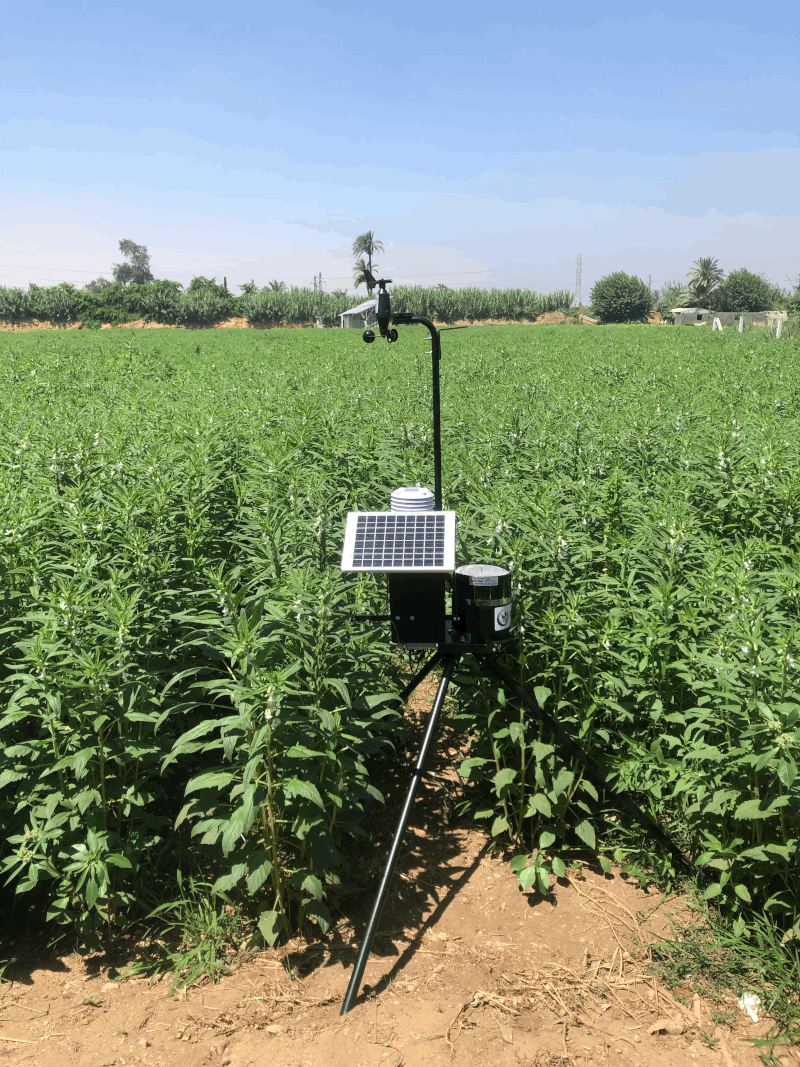
To meet this challenge, GEBAL has supervised the procurement and installation of a comprehensive Farmer Decision Support System at one of the NDWM demonstration plots. As a result, the project bridges the gap between advanced agricultural technology and everyday farming practice.
At the heart of the system is a sophisticated, real-time field monitoring unit. It is powered entirely by off-grid solar panels and batteries, and housed in robust, IP-rated enclosures. In addition, it is equipped with GSM modules for continuous wireless transmission. Because of this, it can rely on two core hardware components to capture localized microclimate and subsurface data around the clock. The system also uses communication modules to transfer real-time data to an online platform, which analyses the readings and informs the farmer when to irrigate.

The system consists of:
1. Integrated Weather Station
This on-site unit continuously tracks atmospheric conditions to calculate Reference Evapotranspiration (ET₀). For instance, it measures:
- Air Temperature
- Atmospheric Pressure
- Relative Humidity
- Wind Speed & Direction
- Rainfall
2. Advanced Soil & Water Sensors
Using independent sensing elements, this unit monitors subsurface conditions as well as input water quality, including:
- Soil Moisture
- Soil Temperature
- Soil Salinity, EC, and Soil pH
- Soil Nutrients (NPK)
- Input Water Salinity
PLACING PEOPLE AT THE CENTER: ACCESSIBILITY AND TRAINING
Technology is only as effective as the community’s ability to use it. That is why GEBAL is overseeing the design of an intuitive, user-friendly digital platform around the hardware. This platform includes continuous data logging, so that performance can be optimized on an ongoing basis.
Specifically, sensor data feeds directly into a dedicated Irrigation Management Software application, available on both mobile devices and computers. Because the app translates complex metrics into an easily readable dashboard, farmers can monitor their farm’s status anytime, from anywhere. In this way, raw data is turned into actionable decisions in the field.
SCALABLE IMPACT: MEASURING SUCCESS
This project serves as a vital proof-of-concept for digital agriculture in the Nile Delta region. Moving forward, GEBAL and GIZ will evaluate how effectively farmers adopt these real-time recommendations in practice. By tracking cost-benefit outcomes across agricultural seasons, the intervention aims to demonstrate measurable gains in water savings and crop yields. In doing so, it aims to prove that combining sustainable, high-precision engineering with dedicated community training can contribute to more sustainable agricultural practices in Egypt’s Delta.

0 Comments